TOP STORY - Medical, Science, and Patient Communities Gather in Germany
Successful 11th International Meeting on Neuroacanthocytosis Diseases Held in Homburg, Germany
by Lars Kaestner

Thank you for reading this 43rd edition of NA News. Here you will find the latest on research, a report on the 11th International Meeting on Neuroacanthocytosis Syndromes held in Homburg in September, an explanation of why the disease nomenclature is changing, well-deserved recognition of Ginger Irvine's efforts, VPS13 forum news, ways in which you can help the advocacy organizations improve their websites, and several patient-focused articles. Read on and enjoy...
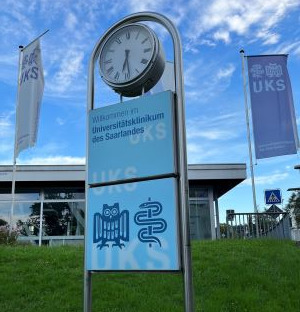 The 11th International Meeting on Neuroacanthocytosis Syndromes was held on September 15th–17th, 2023, at the campus of the Saarland University Hospital of Saarland University at Homburg/Saar, Germany. The conference followed the tradition of the previous ten international symposia; the last in-person meeting was the 9th meeting held in Dresden, Germany in March 2018, followed by an online meeting in March 2021 organized by colleagues from Barcelona. The 11th International Meeting on Neuroacanthocytosis Syndromes was held on September 15th–17th, 2023, at the campus of the Saarland University Hospital of Saarland University at Homburg/Saar, Germany. The conference followed the tradition of the previous ten international symposia; the last in-person meeting was the 9th meeting held in Dresden, Germany in March 2018, followed by an online meeting in March 2021 organized by colleagues from Barcelona.
The conference focused primarily on the disease-related proteins, VPS13A and XK, which are involved in bulk lipid transfer at membrane contact sites. They closely interact forming a protein complex at the contact sites between the endoplasmic reticulum and the cellular membrane system. VPS13A and the other VPS13 proteins (VPS13B-D) belong to the newly acknowledged superfamily of bridgelike lipid transfer proteins (BLTPs). Mutations of the other VPS13 genes cause either neurodegenerative (VPS13C,D) or neurodevelopmental (VPS13B) disorders. While the underlying pathophysiology is not yet known, it is possible that VPS13A and XK diseases, as well as the related conditions, are part of a new group of disorders with a common mechanism of impaired bulk lipid transport.
A total of approximately 20 oral communications were presented in five scientific sessions, accompanied by a keynote lecture by Prof. Adrian Danek entitled “Neuroacanthocytosis syndromes at 70: a term to be retired?” A “Poster-Blitz” session introduced the top seven posters. The 2023 “Glenn Irvine Prize” was given to Dr. Kevin Peikert who gave the prize associated lecture. The panel discussion about “Patient registries, international cooperation & future perspectives” continued the positive developments of the previous meetings regarding the participation and contributions of patients, their families, and caregivers.
A special session regarding red blood cell-related research was a joint session between the 11th International Meeting on Neuroacanthocytosis Syndromes and the “EVIDENCE” project, a doctorate training program funded by the European Community. Further funding bodies include the German Research Foundation (DFG) the Greater Region (consisting of ‘Lorraine’ in France, ‘Wallonia’ in Belgium, ‘Saarland’ and ‘Rhineland-Palatinate’ in Germany as well as ‘Luxembourg’) and the Karlsberg Brewery (Homburg/Saar).
****
This summary was taken from the introduction to the actual article. You may find the full proceedings published in Tremor and Other Hyperkinetic Movements at https://tremorjournal.org/articles/10.5334/tohm.826. You may also enjoy a summary of the proceedings in layman's terms (with photos) found at The Advocacy's website: https://naadvocacy.org/symposia/.
In the meantime, please enjoy a gallery of photos from the meeting, including photos of a unique tree top experience in the Black Forest. Use the arrows to scroll back and forth.
 |
|
| |
2nd Paper Published Resulting from Neuropathology of Neuroacanthocytosis Project
NA-USA funded brain research continues to make progress
by Ruth Walker
 In the last issue of NA News we were pleased to report on the publication of the first scientific article related to the Neuropathology of Neuroacanthocytosis project at the Icahn School of Medicine at Mount Sinai. Dr. Ruth Walker now shares news on a second publication. In the last issue of NA News we were pleased to report on the publication of the first scientific article related to the Neuropathology of Neuroacanthocytosis project at the Icahn School of Medicine at Mount Sinai. Dr. Ruth Walker now shares news on a second publication.
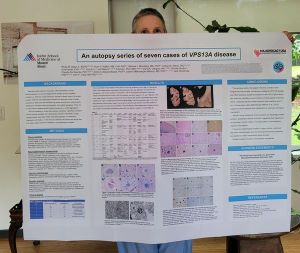 We are delighted to report that our second paper supported by funding from Neuroacanthocytosis Advocacy-USA has now been published on-line, and will be published in print very soon. This is a follow-up to our initial paper which found alterations in levels of certain fats (lipids) in the brains of people with VPS13A disease. Both papers are published in the prestigious journal Movement Disorders. PMID: 37670483 DOI: 10.1002/mds.29589 We are delighted to report that our second paper supported by funding from Neuroacanthocytosis Advocacy-USA has now been published on-line, and will be published in print very soon. This is a follow-up to our initial paper which found alterations in levels of certain fats (lipids) in the brains of people with VPS13A disease. Both papers are published in the prestigious journal Movement Disorders. PMID: 37670483 DOI: 10.1002/mds.29589
For the second paper we examined the brains of seven people with VPS13A disease who so generously donated their brains for research. Thanks to national and international collaborations, we were able to collect this number, which is the largest reported to date of this ultra-rare disease. The work was performed in the lab of Dr. John Crary, in the Pathology Department at Mount Sinai School of Medicine, much of it by NA-USA board member Ricky Ditzel, under the guidance of Drs. John Crary and Ruth Walker.
Prior to our report, the main observations in people with VPS13A has been that there is loss of brain cells in specific regions, and a lot of scar tissue, known as “fibrosis”; there have been no signs of clumps of proteins, such as are typically found in other neurodegenerative disorders, such as Parkinson’s, Alzheimer’s, and Huntington’s diseases. Intriguingly, in addition to the scar tissue which has been seen previously, we found some other features which we hypothesize may be related to dysfunction of fat metabolism within cells. These appeared in brain cells as clumps or grains of material that stained blue with the dyes we used. We also found some other unusual features such as deposition of calcium, and some other markers of damaged cells. Our work will continue to investigate these features further, and we will also perform parallel studies in XK disease (McLeod syndrome).
This project would not be possible without the generous gifts of people affected by NA syndromes, who have donated their brains and other body tissues to us to further our understanding of these awful diseases. Our gratitude also extends, of course, to their families, who work with us ahead of time to deal with the necessary paperwork and other logistics, and who make the critical phone call to us when the time comes, so that we can move quickly to get the most information from this valuable donation.
| |
Ginger Irvine Honored with Service Award
Presitigous Award Given by the Parkinson and Movement Disorder Society
by Despina Dinca
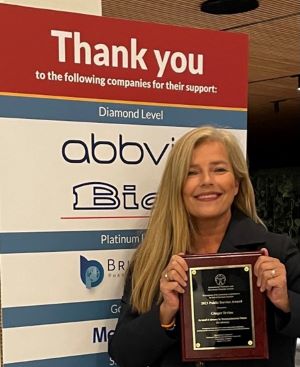
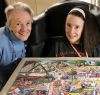 Ginger Irvine, Chair and Co-Founder (with her late husband Glenn) of The Advocacy for Neuroacanthocytosis Patients received the Public Service Award by the International Parkinson and Movement Disorder Society (MDS). The award was presented on 27 August at the 2023 International Congress Welcome Ceremony in Copenhagen, Denmark. Ginger Irvine, Chair and Co-Founder (with her late husband Glenn) of The Advocacy for Neuroacanthocytosis Patients received the Public Service Award by the International Parkinson and Movement Disorder Society (MDS). The award was presented on 27 August at the 2023 International Congress Welcome Ceremony in Copenhagen, Denmark.
[Ginger pictured at right with daughter Alex]
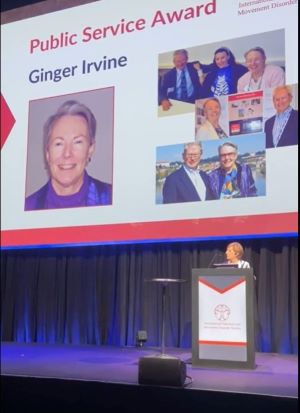 You can watch the Ceremony here: https://fb.watch/mHBVPuWzg4/ and tap from 31'15'' and join the live audience in applauding the lovely presentation given by Dr Emilia Gatto, Chair of the MDS Awards Committee. You can watch the Ceremony here: https://fb.watch/mHBVPuWzg4/ and tap from 31'15'' and join the live audience in applauding the lovely presentation given by Dr Emilia Gatto, Chair of the MDS Awards Committee.
The award was gracefully received in person, on Ginger’s behalf, by Mette Jolly, our former Charity Manager. The Public Service Award recognises individuals or organisations that exhibit the highest standard of excellence, dedication, and accomplishment in public engagement within the field of Movement Disorders. And to give you an idea of its magnitude, this award was presented in 2011 to Michael J. Fox. Here is what Ginger shared while accepting this award:
"We are thrilled and honoured to be recognised as furthering the cause of patients with an ultra-rare disease outside the confines of the clinical world. My husband Glenn and I were introduced to a field of endeavour we never expected to enter. Our experiences with our daughter Alex over the past 25 years have brought new knowledge and understanding and a whole lot of respect for the wide medical world globally.
With the help and support of many, we are pleased to have worked with all the clinicians and researchers who are heading the labs and projects which will lead to better treatments and possibly cures for these rare movement disorders. A special thank you to Professor Adrian Danek, Professor Ruth Walker and Professor Hans Jung for spearheading those efforts for us. And thank you also to our supporters and funders, especially to the Pforzheimer family. Everyone’s efforts help us spreading the word, sharing patients’ stories and ideas and enabling meetings to bring the experts together. This made it possible for us to present a united front to the world and support collectively the strength and resilience of patients, families and carers who face this disease daily.
 I would also like to thank all those people who are accompanying us on this long trail: Alex for her courage and resilience, her sister Jen and her family, all generous friends from around the world, trustees, volunteers, colleagues, and fellow rare disease advocates. Their encouragement, understanding and unwavering support have helped us continue our important work to find better treatments, increased research and improved accessibility for all." I would also like to thank all those people who are accompanying us on this long trail: Alex for her courage and resilience, her sister Jen and her family, all generous friends from around the world, trustees, volunteers, colleagues, and fellow rare disease advocates. Their encouragement, understanding and unwavering support have helped us continue our important work to find better treatments, increased research and improved accessibility for all."
[Mette Jolly received award on behalf of Ginger.]
| |
Neuroacanthocytosis Syndromes at 70: A term to be Retired?
A Primer on Changing Nomenclature
by Adrian Danek
 Adrian Danek helps us understand the reasons behind the changing nomenclature in this field of ultra-rare disease. If you are confused about why XK is rapidly replacing McLeod syndrome and VPS13A is replacing chorea-acanthocytosis (ChAc), then this is the article for you. Adrian Danek helps us understand the reasons behind the changing nomenclature in this field of ultra-rare disease. If you are confused about why XK is rapidly replacing McLeod syndrome and VPS13A is replacing chorea-acanthocytosis (ChAc), then this is the article for you.
 Unequivocal terms are a prerequisite for confronting the world and communicating about it. In 1952, Karl Singer, a hematologist from Vienna and Chicago, introduced the Greek word for thorn/prickle (ἄκανθα) to describe an as yet novel appearance of red cells. The associated disease “acanthocytosis” (of Bassen and Kornzweig) was quickly renamed to abetalipoproteinemia, once its biomarker signature had been discovered. Unequivocal terms are a prerequisite for confronting the world and communicating about it. In 1952, Karl Singer, a hematologist from Vienna and Chicago, introduced the Greek word for thorn/prickle (ἄκανθα) to describe an as yet novel appearance of red cells. The associated disease “acanthocytosis” (of Bassen and Kornzweig) was quickly renamed to abetalipoproteinemia, once its biomarker signature had been discovered.
As the peculiar “thorny” erythrocyte shape was observed also with normal lipoproteins, the existence of further conditions of acanthocytosis (now turned into a mere finding and no longer a singular disease entity) became obvious. Apart from the occurrence in severe liver disease (with “spur cell” as alternative designation for the erythrocyte deformation), various neurological findings were found in association with acanthocytosis. These cases were designated to suffer from neuroacanthocytosis or Levine-Critchley syndrome. The often-quoted series of Hardie et al. (1991), however, has since been found to be genetically heterogeneous. This series contains cases due to mutations in XK, VPS13A, and PANK2. In addition, the index families of Levine et al. (1968) and of Critchley et al. (1968) are now known to harbor mutations of XK and of VPS13A, respectively. (Kaestner Tremor and Other Hyperkinetic Movements DOI: 10.5334/tohm.826 3)
“Neuroacanthocytosis” retains some usefulness [1] as a tentative label while working up a complex case, [2] as an umbrella term to group conditions that are related because their molecular substrates interact (as shown for the XK/McLeod and chorein/VPS13A proteins), and [3] as a tool for advocating for patients and their carers. “Neuroacanthocytosis”, however, does not represent a final medical diagnosis and must be shunned if precision medicine is the goal. Further, its continued use perpetuates the problem of constructing and imagining an entity based on a mere word – as not all patients with VPS13A and XK mutations present with acanthocytosis or with neurological findings, diagnostic delays result from fixation on the outdated term. The terms “XK disease”, “VPS13A disease”, and “PKAN” – even if somewhat “bloodless” – are superior if personalized medicine and, in particular, personalized treatment is pursued. The individual patient with one of these rare and ultra-rare diseases deserves a definite, genetically based diagnosis.
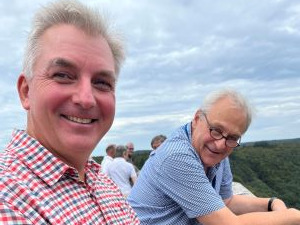
[Note: This article was taken from the Proceedings of the "Eleventh International Meeting on Neuroacanthocytosis Syndromes" published by Tremor and Other Hyperkinetic Movements and compiled by Lars Kaestner. You may find the full proceedings at: https://tremorjournal.org/articles/10.5334/tohm.826. Photo on the right: Lars Kaestner and Adrian Danek.]
| |
Report from 14th VPS13 Forum - July 31, 2023
Linking the Patient and Medical/Science Communities
by Despina Dinca
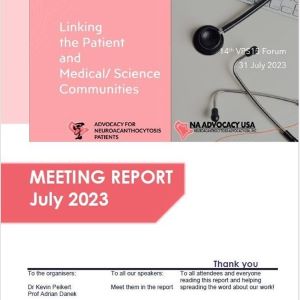
 Linking the Patient and Medical/Science Communities, the recent VPS13 Forum was hosted by The Advocacy and by NA-USA on July 31st. Read on to learn more about our VPS13 forums in general, and details on this one. Linking the Patient and Medical/Science Communities, the recent VPS13 Forum was hosted by The Advocacy and by NA-USA on July 31st. Read on to learn more about our VPS13 forums in general, and details on this one.
If you’ve been with us for a while, you will be familiar with the VPS13 Forum. For those who just joined our newsletter, let us introduce it to you. The VPS13 Forum facilitates continuous conversations (in English) between the international communities of clinicians, researchers and patients and their families and carers. It takes place virtually for two hours every two months under the kind coordination of Dr Kevin Peikert, who is also the recent winner of the Glenn Irvine Prize. To attend future editions of the Forum, please email Kevin (Kevin.Peikert@med.uni-rostock.de).
The 14th edition of the Forum on 31 July 2023 was a special one for us being dedicated entirely to the work of our two advocacy organisations. It covered many important areas from multiple angles: the patients’ perspective, the scientists’ perspective and the clinicians’ perspective. This is why we decided to write all these up as a report.
We invite you to read it and please do share it (on social media or elsewhere) with your network!s
We shared the full English version and a slightly condensed German version and there will be a Spanish version coming soon, too.
The 15th VPS13 forum will be held on November 20th. Be watching your email inbox and social media posts for the announcement.
| |
Your Input Requested
Advocacy Websites Undergoing Review and Updates
by Despina Dinca
 The Advocacy for Neuroacanthocytosis Patients and Neuroacanthocytosis Advocacy USA are both undergoing updates to their respective websites. Read on to discover how you play a critical role in this process. The Advocacy for Neuroacanthocytosis Patients and Neuroacanthocytosis Advocacy USA are both undergoing updates to their respective websites. Read on to discover how you play a critical role in this process.
 This new edition of the NA Newsletter sums up some exciting updates and changes of the past few months. Latest progress in research, nomenclature changes, awards won, prize awarded – you name it, we covered it in NA News! This new edition of the NA Newsletter sums up some exciting updates and changes of the past few months. Latest progress in research, nomenclature changes, awards won, prize awarded – you name it, we covered it in NA News!
To keep up with this dynamic environment, we are undertaking a review of our current website at the same time with the USA website, and we will work together to update them in the next few months.
We aim to provide the same united voice to advocate for those affected by VPS13A and XK diseases while we will be better coordinated with each other in our endeavour to:
- support the patients, their families and carers,
- reach wider communities, and
- have a higher impact in raising awareness.
We are very keen to understand better what you, our audience, would like to see from our online presence. What will be helpful to you? What’s missing? What do you want to read more about? What would you rather see less of?
Drop us a line (or two, or more!) with the answers to those questions. It’s your chance to shine and contribute as part of our lovely NA community. Any ideas and suggestions you have, Despina would love to hear them at despinadinca@naadvocacy.org.
| |
Important Suggestion for XK Patients Regarding Blood Transfusions
A Message from Susan Wagner
by Susan Wagner
 Susan Wagner, president of Neuroacanthocytosis Advocacy USA (NA-USA) shares her brother Mark's experience with his Medic-Alert bracelet. Susan Wagner, president of Neuroacanthocytosis Advocacy USA (NA-USA) shares her brother Mark's experience with his Medic-Alert bracelet.
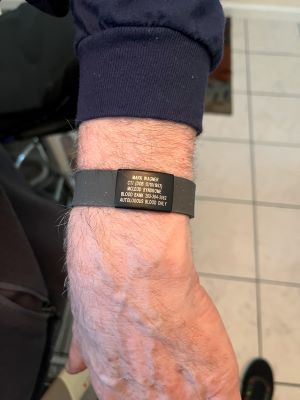 Greetings to all McLeod syndrome (XK) patients from the family of my brother Mark Wagner, a McLeod syndrome patient. We wanted to reach out to you with a suggestion from brother Mark’s hematologist doctor. His doctor recommended Mark wear a bracelet to alert medical personnel of his condition, and the telephone number to call to access where his frozen blood is being stored. Greetings to all McLeod syndrome (XK) patients from the family of my brother Mark Wagner, a McLeod syndrome patient. We wanted to reach out to you with a suggestion from brother Mark’s hematologist doctor. His doctor recommended Mark wear a bracelet to alert medical personnel of his condition, and the telephone number to call to access where his frozen blood is being stored.
There is a medical need for McLeod syndrome patients to bank and freeze their own blood to avoid possible blood transfusion reaction since their blood lacks Kell antigen. Brother Mark has had his blood (autologous) frozen to circumvent this possibility.
Mark’s bracelet was ordered on Amazon:
https://www.amazon.com/Road-ID-Medical-Alert-Bracelet/
There are many others types available on Amazon, different styles, colors and pricing. Mark’s cost $54.99.
Any questions feel free to contact me.
Susan Wagner
President, NA-USA
susan@naadvocacyusa.org
A Patient-eye View
Bob Metzger Shares His Experience at the Recent International Meeting
by Bob Metzger
 Bob Metzger, a board member of NA-USA and XK patient, shares highlights of his attendance at the 11th International Meeting on Neuroacanthocytosis Diseases. Bob Metzger, a board member of NA-USA and XK patient, shares highlights of his attendance at the 11th International Meeting on Neuroacanthocytosis Diseases.
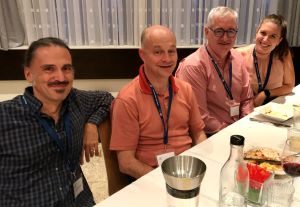 My sister, Vicki Spray, and I had the opportunity to attend the symposium this year together. This was a thoroughly enjoyable time. This article is to share highlights. My sister, Vicki Spray, and I had the opportunity to attend the symposium this year together. This was a thoroughly enjoyable time. This article is to share highlights.
It started out Friday morning with a free acupuncture session, a relaxing and rejuvenating experience. On Saturday, I had the opportunity to participate in an exercise diagnostic at a nearby Sports Medicine facility.
On Sunday morning, I had the privilege of providing blood that will be used for a variety of reasons one of which is to help increase knowledge of how to use a certain machine.
I feel the top highlight of the whole weekend for me was making personal connections. I got to know patients and their family members, both from the U.S. as well as other countries. I also made connections with researchers and clinicians. During our mealtimes I took the opportunity to sit with different people and get to know them more personally. My sister and I sat with researchers from Spain at our first evening meal. On Saturday all participants took a break from the formal scientific talks and had an excursion out to a park and then a multi-course meal with wine tasting. At this meal I sat with a group of six young individuals who are working on their doctoral degrees. This was enjoyable getting to talk to these students and hear about what they are working on and share my own story of navigating this disease. During one lunch I sat with a group of patients all of whom were from a country other than the U.S. Although a language barrier definitely slowed and limited the communication they all did graciously use their limited English and ‘Google Translate’ was helpful. Some of these patients I had met at a previous symposium. It was a joy to reconnect.
It wasn’t only just at meals. It was very rewarding to have significant conversation with patients at other times. One occasion stands out when I sat with Rudiger, a German speaking patient. I am super grateful to Diana for sitting with us and translating.
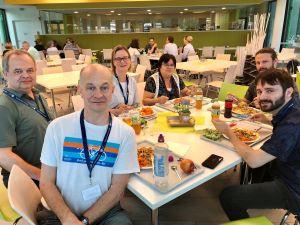 Throughout the weekend we got to hear a number of informative talks. Some of the time just the patients and family members were together in a separate room. Some of the time everyone (patients/carers/clinicians/researchers) were together for these talks. Very educational. Throughout the weekend we got to hear a number of informative talks. Some of the time just the patients and family members were together in a separate room. Some of the time everyone (patients/carers/clinicians/researchers) were together for these talks. Very educational.
All in all this was a very enjoyable rewarding experience. I am super glad I was able to attend. I look forward to the next symposium.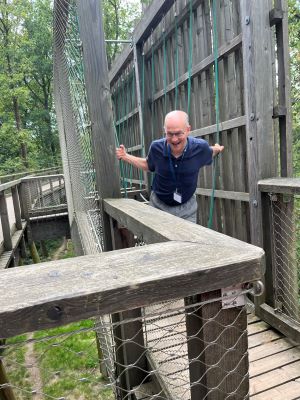
| |
XK Patient Becomes "Exhibit A" at University Grand Rounds
Mark Williford and Ruth Walker Contribute to Better Understanding of XK Disease
by Joy Willard-Williford
 XK patient Mark Williford and Professor Ruth Walker joined forces to present on neuroacanthocytosis diseases and XK in particular for Grand Rounds at the University of Florida's Norman Fixel Institute for Neurological Diseases. XK patient Mark Williford and Professor Ruth Walker joined forces to present on neuroacanthocytosis diseases and XK in particular for Grand Rounds at the University of Florida's Norman Fixel Institute for Neurological Diseases.
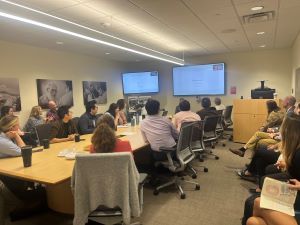 October 24 found XK patient Mark Williford and wife Joy at the University of Florida Health Norman Fixel Institute for Neurological diseases in Gainesville. Mark was exhibit A for Grand Rounds. This was a voluntary visit initiated by Joy and assisted by Ruth Walker. Joy reached out to Dr. Michael Okun, executive director of the Institute and University of Florida professor of Neurology and volunteered Mark. It is so important to educate young clinicians and researchers, as the prevalence of the McLeod syndrome is 1:10,000,000. Few students would ever get the opportunity to examine a patient themselves.
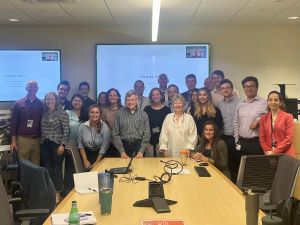 Dr. Ariane Carpentier Dr. Ariane Carpentier, a Canadian movement disorder fellow at the University of Florida, organized a splendid presentation and patient interview. Dr. Ruth Walker of the Bronx VA and Mount Sinai School of Medicine zoomed in to present on the neuroacanthocytosis diseases and McLeod syndrome specifically. Of special note was the showing of a video of Mark from 2009 (UF is where he was diagnosed). There were about 25 members of the faculty and movement disorder fellows present, as well as a geneticist, a speech therapist, and a physical therapist. Mark and Joy's daughter Katie and son-in-law Travis were present, too. Afterwards Mark enjoyed Ariane’s pumpkin pie as he retired to the fellows’ office for more Q&A and a new videoed neuro exam.
| |
Patient Expresses Her Creativity
Check out Alex Irvine's Watercolours
by Joy Willard-Williford
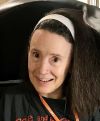 Patient Alex Irvine enjoys expressing her creativity. Patient Alex Irvine enjoys expressing her creativity.
Londoner Alex Irvine lives with VPS13A disease and inspires us all with her determination and creativity. She and her mother, Ginger Irvine, love to do puzzles, usually cat-themed puzzles. Alex is assisted in her watercolour paintings by artist friend Martin Ireland. Check out some of their work in the slideshow below.
If you are a patient or know of a patient who would like to share any creative endeavours or stories about any other interesting activities, we would love to hear from you! Just send your story and photo(s) to joy@naadvocacyusa.org.
|
|
|